
The Politics of Performance: Propaganda, Power, and the Illusion of Development.
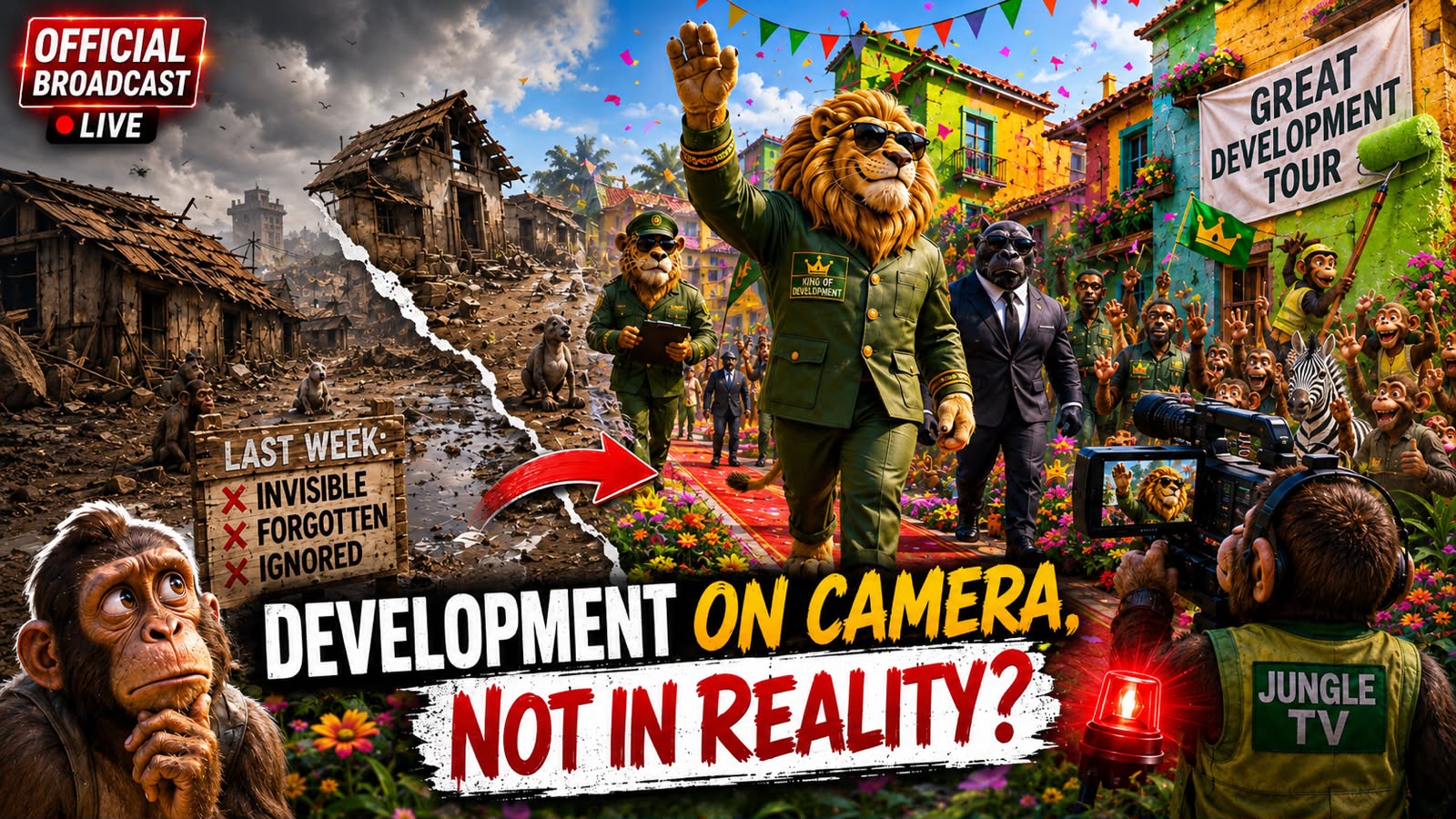
A Satirical Reflection on Propaganda, Public Perception, and Modern Political Power.
In a fictional jungle gripped by political tension,
excitement is spreading rapidly across the savannah. The Panther’s Freedom
Concert has captured the public imagination with its message of resistance,
justice, and social awakening. Yet just as public attention begins shifting
toward questions of inequality and accountability, the lion suddenly announces
a highly publicised “Development Tour” across the kingdom.
Almost overnight, neglected roads are repaired,
flowers appear in drought-stricken areas, and villages abandoned for years
receive urgent attention moments before cameras arrive. Officials who were
previously invisible suddenly become energetic and responsive. To many
citizens, the transformation appears encouraging. The kingdom finally seems
active.
But beneath the celebration lies a deeper political
question: when development only appears under the spotlight of public
attention, is the goal genuine progress or a carefully managed perception
designed to deceive?
This satirical animal story explores one of the most
enduring realities of political systems throughout history: power survives not
only through authority but also through narrative control. In today’s
media-driven political climate, leadership increasingly depends not just on
what governments do, but on what citizens are encouraged to see, repeat, and
emotionally associate with those in power. Recognising this empowers citizens
to analyse political messages critically.
One of the most revealing moments in the story comes
through the monkeys rehearsing cheers before the lion’s arrival. While humorous
on the surface, the scene symbolises a darker political reality where loyalty
is often organised, staged, incentivised, or socially enforced, blurring the
line between authentic approval and performative allegiance.
The timing of the Development Tour is equally
significant. It is launched precisely when the panther’s message begins
spreading through livestreams, music, and public conversations. Citizens are no
longer discussing entertainment alone; they are beginning to question freedom,
inequality, corruption, and leadership accountability.
Instead of directly confronting these growing
frustrations, the system introduces a competing emotional narrative: visible
development.
This reflects a political strategy repeatedly
witnessed throughout history. When criticism becomes difficult to silence
completely, governments often redirect public attention instead. Spectacle
becomes a mechanism of control. Grand tours, public ceremonies, ribbon-cutting
events, and dramatic announcements frequently intensify during periods of
political discomfort or declining public trust.
The central question, therefore, remains: when progress only becomes visible during moments of public attention, how can societies tell the difference between authentic change and political performance?
Video: https://youtube.com/shorts/lZYxytoqB7E?si=dIitgMTy_WmizHjU