
Do We Really Believe What We Preach? A Satirical Reflection on Faith, Fear, and Religious Hypocrisy.
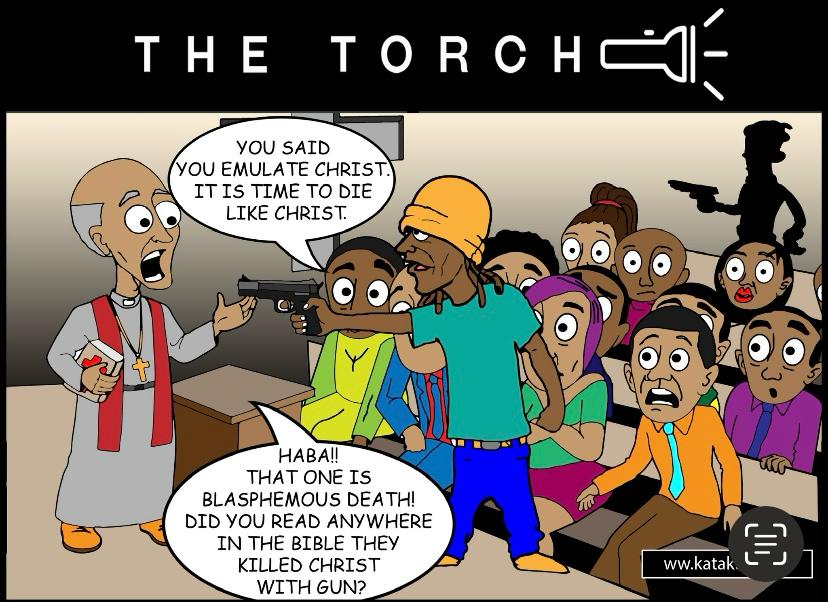
Do our actions match our beliefs? A thought-provoking question that requires soul-searching, one would argue.
Religious
teachings shape the lives of billions of people around the world. Every week,
places of worship echo with messages about faith, sacrifice, courage, hope, and
eternal life. Believers are encouraged to trust God, overcome fear, and live
according to spiritual principles.
Yet an
uncomfortable question sometimes emerges: do our actions always reflect the
beliefs we profess?
A humorous
church satire explores this question through an unexpected exchange between a
priest and one of his congregants. During a sermon encouraging believers to
emulate Jesus Christ, a man takes the message literally and announces that it
is "time to die like Christ." Shock spreads through the congregation,
but the priest quickly interrupts, pointing out that Christ was not killed with
a gun.
The humour
comes from the absurd misunderstanding. Yet beneath the laughter lies a deeper
conversation about faith, literal interpretation, fear, and the gap that can
sometimes exist between religious teaching and human behaviour.
Religious
language is often rich with symbolism. Expressions such as "carry your
cross," "die to self," and "be like Christ" are
intended to communicate spiritual principles rather than instructions for
literal imitation.
The church
satire highlights how easily confusion can arise when religious teachings are
separated from their intended context. Christianity calls believers to imitate
Christ's character—His compassion, humility, forgiveness, and love—not
necessarily every historical event of His life.
Without
understanding context, even sincere teachings can be misunderstood.
The story
can also be understood in another way.
When the
priest encourages believers to follow Christ but quickly distances himself from
the practical consequences of that statement, the satire invites a more
uncomfortable question: how deeply do people actually believe the messages they
proclaim?
Throughout
history, faith traditions have encouraged believers to trust in divine
protection and providence. Yet critics often point to situations where some
religious leaders preach complete dependence on God while surrounding
themselves with extensive security measures, armed guards, or special
privileges unavailable to ordinary followers.
The issue
is not whether personal security is wrong. Most people would agree that taking
reasonable precautions is both sensible and responsible. Rather, the satire
asks whether there is sometimes a contradiction between public declarations of
absolute faith and private expressions of fear.
When
actions and words point in different directions, people naturally begin to
question which one reveals a person's true convictions.
The tension
between faith and fear is not unique to religious leaders. It is a universal
human experience.
Most people
claim values they struggle to practice consistently. People speak about honesty
yet tell small lies. They advocate courage yet avoid difficult situations. They
promote generosity while protecting their own interests.
Religious
communities are no exception.
The church
joke resonates because it exposes a reality many people recognise: believing
something in theory is often easier than living it in practice. Fear,
self-preservation, and uncertainty can influence behaviour even when
individuals sincerely hold strong religious convictions.
Some people
view critical thinking as a challenge to religion, but thoughtful reflection
has long been part of religious scholarship.
Asking
whether actions align with beliefs is not an attack on faith. In many cases, it
is an expression of the seriousness of faith. Genuine conviction should be
strong enough to withstand honest questions and self-examination.
Critical
thinking encourages believers to distinguish between symbolic language and
literal instruction, and to examine whether personal behaviour reflects
professed values.
Humour has
always been one of society's most effective mirrors. Satire reveals
contradictions by presenting them in exaggerated or unexpected ways.
This church
story works because it operates on two levels simultaneously. On one level, it
highlights the dangers of taking religious teachings too literally. On the
other hand, it raises questions about the consistency between preaching and
practice.
The
laughter comes from recognising truths that might otherwise be uncomfortable to
discuss openly.
Perhaps the
greatest lesson from this satire is that genuine belief involves more than
repeating religious phrases. It requires understanding, conviction, and a
sincere effort to live according to one's professed values.
Faith is
not merely demonstrated through words spoken from a pulpit or repeated in a
congregation. It is revealed through actions, decisions, and responses when
real-world circumstances test beliefs.
The story
reminds us that understanding faith is important, but so is examining whether
our actions truly reflect what we claim to believe.
Sometimes
the funniest jokes ask the most serious questions.
Whether
viewed as a lesson about literal interpretation or as a commentary on religious
hypocrisy, the satire challenges believers and non-believers alike to examine
the relationship between words and actions.
Do we
really believe what we preach? Or do our actions sometimes reveal doubts,
fears, and contradictions that our words attempt to hide?
The answer
may be uncomfortable, but it is worth considering.
What do you
think? Can religious teachings be misunderstood when taken too literally? Is
there sometimes a gap between what religious leaders preach and what they
practice? Share your thoughts respectfully in the comments.
Watch the video: https://youtu.be/A68vNqpe4fs
Related
reading:
Five Hours
in Bed: A Satirical Look at Sexual Performance Pressure and Modern Masculinity:
https://katakata.org/news/-1780399007
Bulletproof
Donkey: Faith, Fear, and the Performance of Spiritual Power:
https://katakata.org/news/-1780132192
Gold Does
Not Lose Its Value: A Conversation on Love, Judgment, and Second Chances:
https://katakata.org/news/-1781267558